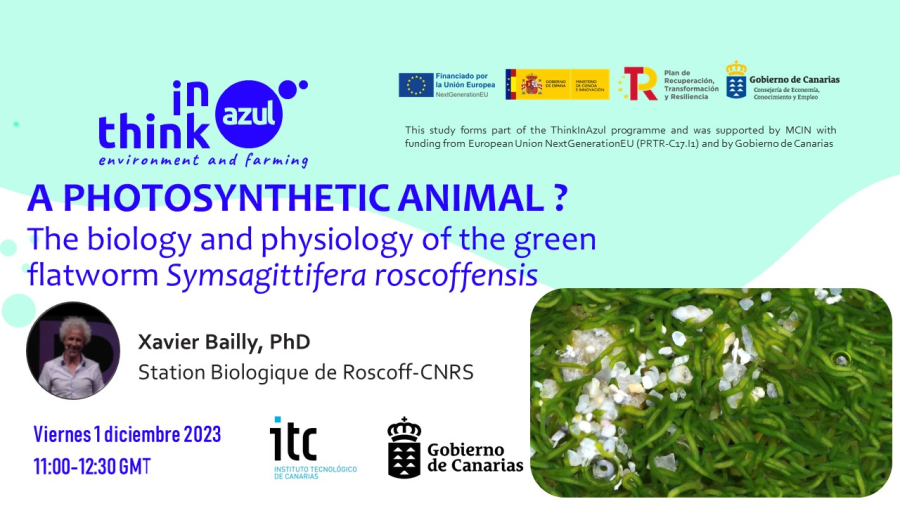
Xavier Bailly works at the French National Centre for Scientific Research (CNRS), more specifically at the Marine Biological Resources Center in Roscoff (France).
About his webinar presentation:
Some marine invertebrates have developed a long-term functional partnership with photosynthetic micro-algae that reside and live inside the animal tissues. The biology and physiology of the green flatworm Symsagittifera roscoffensis show how a proliferating population of around 100,000 photosynthetically active unicellular green algae (Tetraselmis convolutae) is controlled under the epidermis of this animal. The non-photosymbiotic juvenile animal must ingest (not digest) the micro-algae present in the surrounding environment or perish if no ingestion occurs. Once ingested, the algae divide, impart the green color to the animal, and provide energy, releasing various photosynthates and metabolites into the tissues - the sole source of food for the animal.
Controlling the life cycle in captivity of this flatworm - including inducing photosymbiosis from culture of the free photosynthetic partner - provides access to all developmental stages to functionally explore the modus vivendi of this intimate relationship. Rearing in captivity this composite species has been a crucial challenged solved with an interdisciplinary collaboration associating biologist and physicist/mathematicians : they together opened a new avenue with an innovative eco-mimicking algorithm which realistically calculates and predicts the solar energy access which has driven the evolution of/ adaptation of this photosymbiosis. In the natural environment, animals are exposed for several hours a day to sunlight and are adapted to cope with sunlight (including UV) and high oxygen concentration (through photosynthesis) in their tissues. Apart from dealing with potentially adverse physiological conditions (oxidative stress), S. roscoffensis also demonstrates strong tissue regeneration capabilities, including its brain. The biology and ecology of this photosymbiotic worm will be comprehensively presented, from photosymbiosis to its regenerative capacities and as an inspiration for the development of bio-regenerative life support systems for space exploration.
 Español
  English















 Conócenos
  Ámbitos de Actuación
  Equipo
  Instalaciones
  Hitos
Hitos  Tecnología
  Casos de Éxito
  ITC en Cifras
  Agua
Agua  Análisis Ambiental
  Biotecnología
  Computación Científica y Tecnológica
  Energías Renovables
  Ingeniería Biomédica
  Innovación
  Servicios Institucionales y Metrología
  Sociedad de la Información